
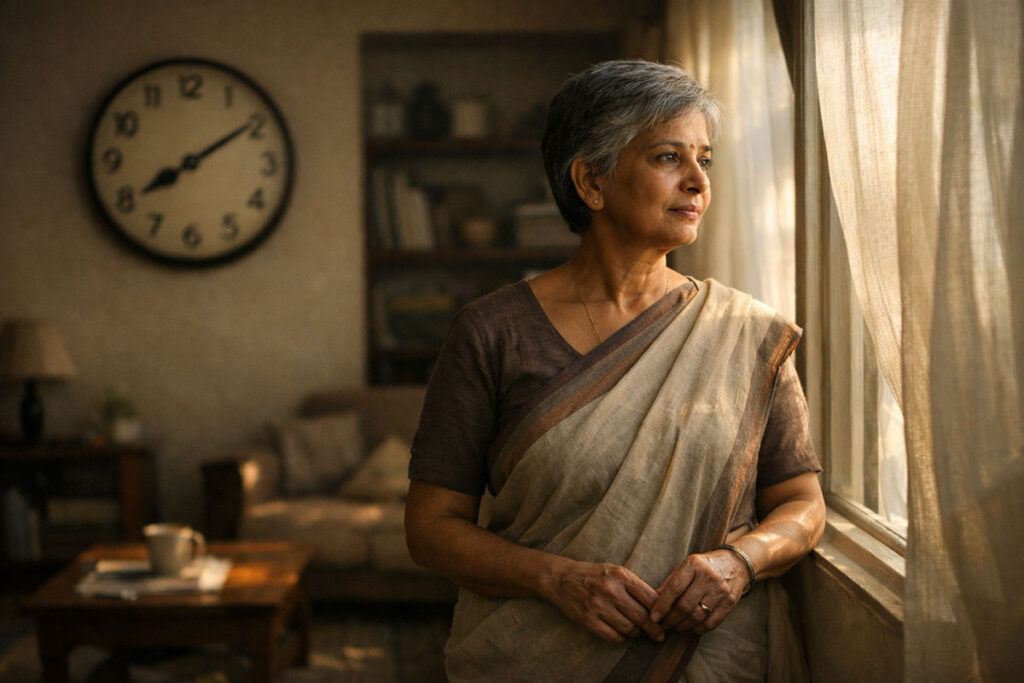
After retirement, she realized silence wasn’t peaceful—it was asking a question she’d spent decades avoiding.
Table of Contents
- The First Morning Without Work
- Rooms That Remembered More Than She Did
- The Diary Under the Bed
- When Silence Began to Feel Heavy
- An Unexpected Invitation
- Drawing the First Line
- Learning to Define a Boundary
- What the House Was Really Asking
The First Morning Without Work
The clock ticked louder than usual.
It had always ticked that way, of course. But on her first morning after retirement, Meera heard it as if it had been waiting for her attention.
She woke at six, as she had for nearly four decades. For a few seconds she lay still, expecting the familiar urgency—the rush to iron a sari, pack her tiffin, catch the bus. Instead, there was only the ceiling fan turning slowly above her.
No files to finish. No supervisor waiting.
Just the hum of the refrigerator and sunlight filtering through thin curtains.
She made tea anyway.
From the veranda, she watched school vans honk impatiently and neighbors sweep their steps. The world moved with purpose. She held her cup with both hands and felt strangely unassigned.
For thirty-eight years she had worked at the same municipal office. Same desk. Same green drawers that stuck during monsoon. Her chair had changed twice. She had not.
Retirement had been described as freedom.
It did not feel like freedom.
It felt like an empty calendar.
Rooms That Remembered More Than She Did
By nine, the house was spotless.
She swept, mopped, rearranged jars in the kitchen, wiped the counter twice. At ten, she stood in the hallway and looked at the closed bedroom doors.
Her son’s old cricket bat still leaned against the wall. Her daughter’s study table remained under the window, one drawer slightly open.
Both children lived abroad now. Weekly video calls. Photos on birthdays. Questions about her blood pressure and whether she was eating properly.
“Come stay with us,” her daughter often said.
“For how long?” Meera would reply.
“As long as you want.”
But Meera had never been good at arriving without purpose.
After her husband Prakash passed away seven years earlier, relatives had filled the house with food and instructions.
“You must stay strong,” they said. “For the children.”
She had returned to work within two weeks.
Work was easier than sitting alone with grief.
The Diary Under the Bed
One afternoon, while cleaning a shelf she had already cleaned, she found an old diary.
It was hers. The handwriting gave it away.
The first entry was dated thirty years ago.
“Sometimes I wonder if I will ever do something only because I want to.”
She sat on the floor, reading slowly.
“I wanted to apply for the training program in Delhi. Prakash said it’s too far.”
“Maybe next year I’ll take painting classes.”
“Children are small now. Later.”
Later. The word appeared again and again.

She did not remember feeling deprived. She had simply been busy—busy being responsible, efficient, dependable.
The diary did not accuse her.
It reminded her.
When Silence Began to Feel Heavy
In the first few weeks, the silence felt like relief.
No deadlines. No interruptions. No rush to cook before a power cut.
But slowly, the quiet changed shape.
She began noticing every small sound—the ceiling fan clicking, the bathroom tap dripping faintly at night. She turned on the television for company, keeping the volume low, not really watching.
One evening she stood in front of the mirror longer than usual.
When had her hair turned completely grey? When had the lines around her mouth deepened?
She realized something that unsettled her more than loneliness:
She did not know what she liked anymore.
Sweet tea or less sugar? Morning walks or late evenings? Music or silence?
For decades, choices had been practical.
Now there was time.
Time, she discovered, could feel heavier than responsibility.
An Unexpected Invitation
The turning point did not arrive dramatically.
It came on a warm Tuesday afternoon when the electricity went out and she opened the windows for air.
From the neighboring balcony, Mrs. D’Souza called out cheerfully.
“You look free these days. Enjoying retirement?”
“Yes,” Meera answered automatically.
“I’ve joined a community group at the library. We meet twice a week. You should come.”
Her first instinct was to refuse.
But something inside her hesitated.
“What do you do there?” she asked.
“Oh, nothing serious. We talk. Sometimes someone teaches something. This week, one of the ladies is showing us how to sketch.”
Sketch.
The word stayed with her long after the conversation ended.
That evening, she pulled out an old box from under the bed. Inside were dried watercolors and stiff brushes.
She had once planned to paint with her daughter.
They never did.
Drawing the First Line
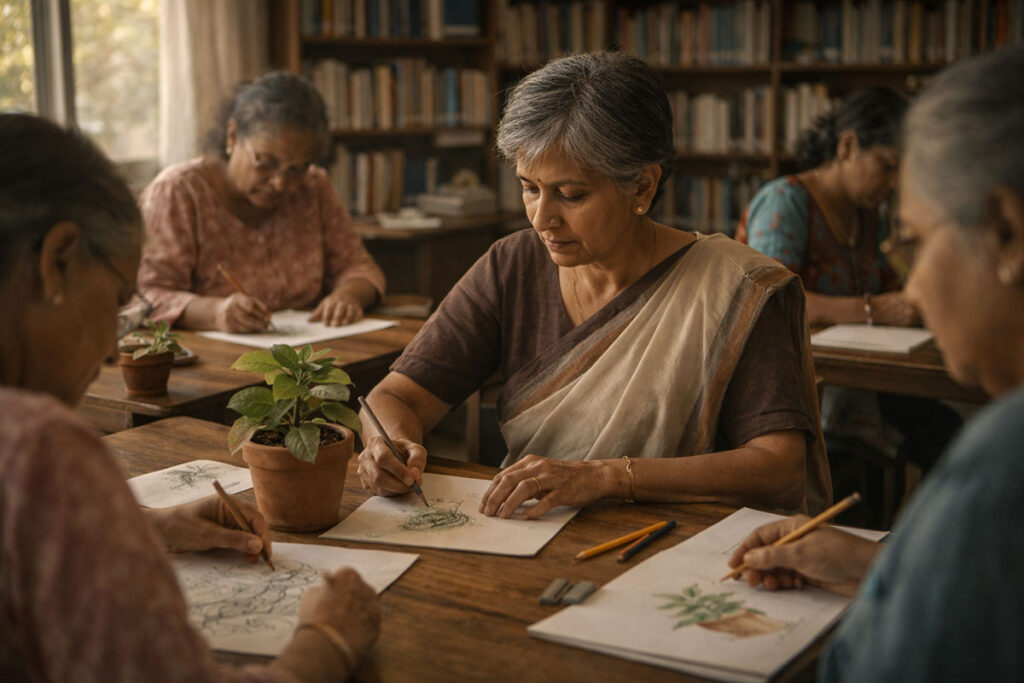
At the library, the room was small and bright. About a dozen women sat around a long table. They introduced themselves without grand stories.
When it was her turn, Meera said simply, “I just retired.”
The instructor handed her a pencil.
“Don’t worry about being good,” she said. “Just draw what you see.”
Meera stared at a potted plant.
Her first lines were careful, almost fearful. The leaves looked stiff.
She considered stopping.
Then she remembered the diary.
She kept going.
Nothing extraordinary happened that day. She did not discover hidden talent. No one applauded.
But she returned the next week.
And the week after that.
At home, small changes followed. She moved the dining table closer to the window. Donated utensils she never used. Packed away the cricket bat after asking her son’s permission.
“It’s time,” she told him.
It was the first time she had rearranged the house not out of necessity, but choice.
Learning to Define a Boundary
A month later, her daughter called with news.
“We’re expecting,” she said, voice trembling.
Joy rose in Meera’s chest like a quiet tide.
“You’ll have to come stay with us,” her daughter added. “At least for a few months.”
This time, Meera did not answer immediately.
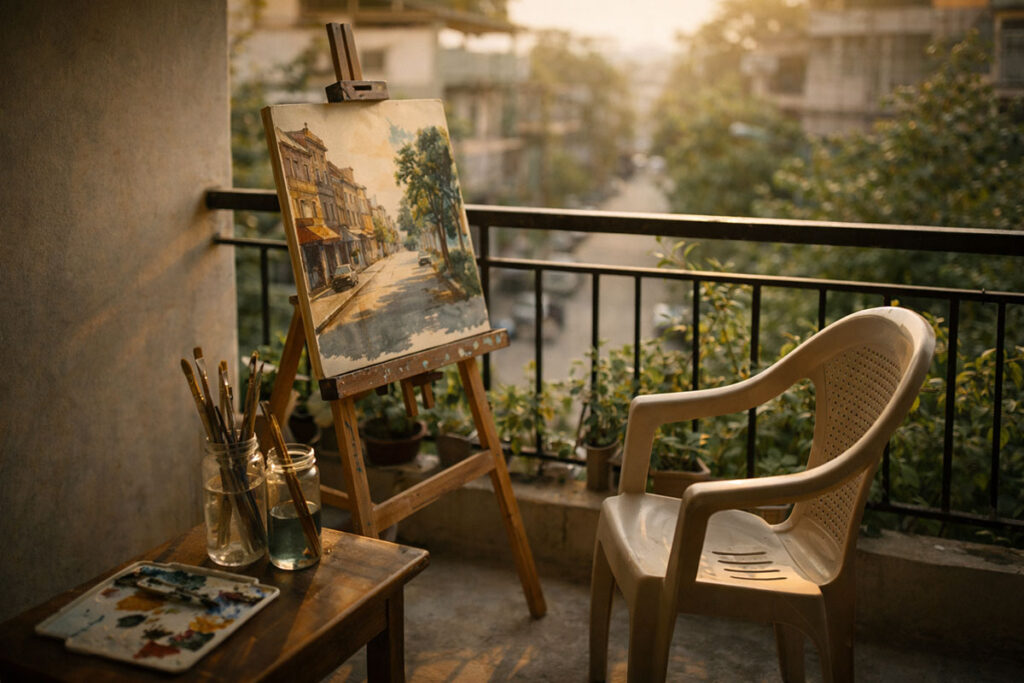
She looked at her veranda—at the small easel, the jars of paintwater, the unfinished canvas of the street outside.
“I will come,” she said slowly. “But not to stay forever.”
There was a pause on the line.
“Of course,” her daughter replied gently.
It was a small sentence.
But for Meera, it was something larger.
She had never before defined her presence so clearly.
Not as refusal.
As balance.
What the House Was Really Asking
The house remained quiet.
The clock still ticked. The refrigerator still hummed.
But the silence no longer pressed against her.
It felt like space.
She began experimenting with breakfast recipes. Burned some. Laughed alone in the kitchen. Framed one of her paintings and hung it in the hallway.
When neighbors visited, they noticed.
“You made this?” they asked.
“Yes,” she said, and allowed herself to enjoy the surprise.
There were still lonely afternoons. Grief did not vanish because she picked up a brush. She sometimes missed Prakash sharply—the way he folded the newspaper, the quiet cough from the bedroom.
But the ache felt different now.
It was not regret.
It was recognition.
On the anniversary of her retirement, she opened her diary again and wrote:
“I am learning to listen to what I want. It feels unfamiliar. But not wrong.”
That night, she turned off the television.
The house was still quiet.
But it was no longer waiting.
It had not been asking why she was alone.
It had been asking who she was when no one needed her.
And finally, she was beginning to answer.
Disclaimer:
This story is a fictionalized narrative inspired by real-life emotional experiences.